Skyscraper technique explained: it is not one thing, and that is why you are confused
Type "skyscraper technique" into a search box and you will get two completely different answers fighting for the same page. One camp will tell you about a Sudoku solving pattern. The other will tell you about a content marketing strategy for outranking competitors. Both are correct. Neither side acknowledges the other exists, and that is exactly why so many readers walk away more confused than when they started.
I ran into this mess myself. I was researching advanced Sudoku patterns for a puzzle project, landed on a page promising the "skyscraper technique explained," and got three paragraphs about backlink outreach before I realized I was on the wrong kind of website. So let me do what almost nobody bothers to do: separate the two meanings cleanly, then go deep on the one you probably came for.
Key takeaways
- The term covers two unrelated things: a Sudoku elimination pattern and a link-building content strategy.
- The Sudoku Skyscraper is an advanced single-digit technique, sitting between simpler patterns and full-blown chaining methods.
- The content Skyscraper is about finding what already ranks well, then making something measurably better.
- Neither version is a silver bullet. Both reward patience and punish shortcuts.
- Confusing the two is common, harmless, and entirely fixable in about ninety seconds.
The two meanings, separated once and for all
Here is the clean split.

Skyscraper (Sudoku): a solving pattern that lets you eliminate a candidate digit from cells you could not previously touch. It belongs to the family of "single digit" techniques, meaning you only look at one number at a time across the whole grid.
Skyscraper (content marketing): a strategy where you identify a page that performs well for a keyword, then publish a version that is genuinely better, and reach out to the people linking to the original. The term was popularized by Brian Dean of Backlinko, who built a good chunk of his early audience on it.
Same word. Zero overlap. If you searched for one and got the other, you are not losing your mind.
Which one do you actually want?
Ask yourself what you were doing five minutes ago. If you had a 9x9 grid open and a pencil in your hand, you want the Sudoku version. If you had an analytics dashboard open, you want the content version. If you had both open, congratulations, you are my kind of chaotic.
The Sudoku Skyscraper: advanced elimination without guessing
The pattern is built on a specific condition. You need two rows (or two columns) where a given candidate appears in exactly two cells each. Not one, not three. Exactly two. When that happens, and the two pairs line up on a shared column in a particular way, you can start striking candidates from cells that see both of what solvers call the "rooftops."
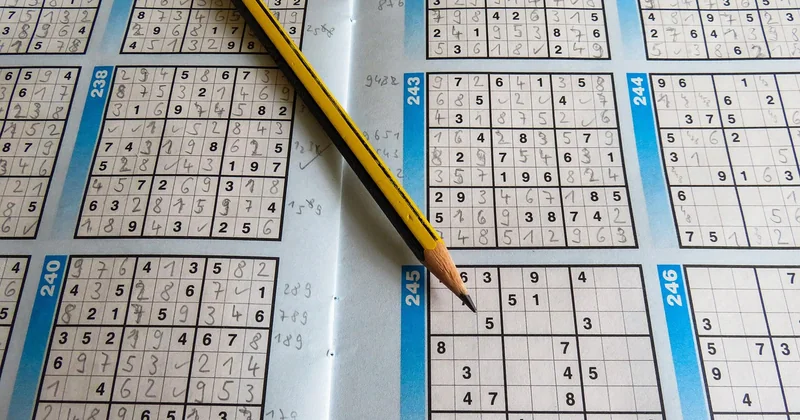
That is the mechanical definition, and it is dry enough to put you to sleep. The reason people remember it is the metaphor.
Why is it called a skyscraper?
Picture two buildings standing next to each other. One is taller. They share a common base along one line, and their upper floors are offset. In Sudoku terms, the "shared base" is the column where both candidate pairs have a cell, and the "offset towers" are the cells sticking out on their own. Any candidate that can see both towers gets eliminated.
I will be honest: the metaphor did not click for me on paper. What clicked was solving the same puzzle three times and watching the elimination work in a different order each time. The name is memorable, but the logic is what you actually need.
Skyscraper vs X-Wing: what is the real difference?
This is the comparison that trips up most solvers, and it is worth getting straight because the two patterns look almost identical at a glance.
| Feature | X-Wing | Skyscraper |
|---|---|---|
| Candidate cells per line | Exactly two | Exactly two |
| Alignment of pairs | Both pairs perfectly aligned on a shared row or column | Only one cell of each pair aligns |
| What gets eliminated | Candidates from all four corners of the rectangle | Candidates that see both rooftop cells |
| Typical difficulty | Intermediate | Advanced |
An X-Wing is a rectangle. A Skyscraper is a rectangle with one wall knocked out. That single missing alignment is what makes the elimination less obvious and the technique harder.
Where does it sit relative to Turbot Fish and similar patterns?
The Skyscraper is often taught as a stepping stone toward the Turbot Fish family, which includes more elaborate chains. If X-Wing is arithmetic and Turbot Fish is algebra, Skyscraper is the geometry class in between. You can solve most hard puzzles without ever reaching for the bigger patterns if you master this one properly.
My advice: do not learn five patterns at once. Pick Skyscraper, solve twenty puzzles where it applies, and let it become instinct before you touch chaining.
The content Skyscraper: build something better, then say so
The marketing version is simpler to explain and much harder to execute. The premise is that ranking is not about being first. It is about being the most complete, most useful, most linkable answer to a query. So you find the current best answer, study it, and then build something that beats it on a dimension that matters.

When I first tried this years ago, I made the classic error. I took a well-ranking article, added two hundred more words, changed the title, and published. It did nothing. Absolutely nothing. I got maybe a dozen visits in three months.
The reason is now obvious to me. Longer is not better. Better is better. And better has to be visible in the first screen.
What "better" actually means in practice
Here is what worked when I tried again on a different topic:
- A comparison table the original did not have
- An answer to the most common objection in the comments section of the competing page
- A worked example with real numbers instead of abstract advice
- Shorter sentences, because the original was written in that heavy academic register nobody enjoys
- A downloadable checklist, which is the one thing that earned me actual backlinks
The checklist did more for that page than every other improvement combined. Specificity wins.
The half everyone skips: outreach
Building the better page is maybe forty percent of the work. The rest is telling people about it, and this is where most attempts die.
You find pages linking to the original. You check whether they might reasonably link to yours instead, or as well. You write to them. And you get ignored, repeatedly, in a way that is genuinely demoralizing the first time.
Real talk: my first outreach round had a reply rate I am embarrassed to state. It got better once I stopped sending the same template to fifty people and started actually reading each site first.
Mistakes I have made in both versions
In Sudoku, I spent weeks applying Skyscraper eliminations that were invalid because I had miscounted the candidates in one row. One miscount, and the whole pattern collapses. Check your pairs twice.
In marketing, I built a "better" page for a keyword where the top results were all from major brands with enormous domain authority. That page had no chance. I should have picked a keyword where I could realistically compete.
Both mistakes share a root cause. I skipped the verification step because I was excited to get to the interesting part.
Short answers to the questions people keep asking
Is the Skyscraper technique worth learning for Sudoku? Yes, if you are already comfortable with basic elimination and want to move past guessing. No, if you are still learning the fundamentals, because it will feel like noise.
Does the content version still work in 2026? It works better than it did when everyone was publishing shallow listicles, and worse than it did when almost nobody was doing it well. The bar has moved. The principle has not.
Can you combine the two meanings? Only as a bad joke. I have tried. It does not land.
Where to start, whichever version you came for
If you are here for Sudoku, open a hard puzzle, pick one digit, and scan every row and column for lines where that digit has exactly two candidate cells. Once you have those pairs, look for the shared-column setup. Do this ten times and you will stop needing the metaphor.
If you are here for marketing, pick one keyword you can plausibly win, find the page currently ranking, and ask a single question: what would make this genuinely more useful to a real person? Answer that, build only that, and then spend twice as long on outreach as you did on writing.
The uncomfortable truth is that both versions of the Skyscraper technique are less about the pattern and more about the discipline around it. The pattern is the easy part. The verification, the outreach, the twenty repetitions before it becomes instinct: that is the work. Most people quit somewhere in the middle of it and blame the technique.
It was never the technique.